Introduction to TabFM
The vast majority of business data is tabular, living in data warehouses, CRMs, and financial ledgers. However, building a reliable model from it still means training a new one from scratch for every dataset, then maintaining hyperparameter tuning loops, feature engineering, and retraining pipelines to fight data drift.
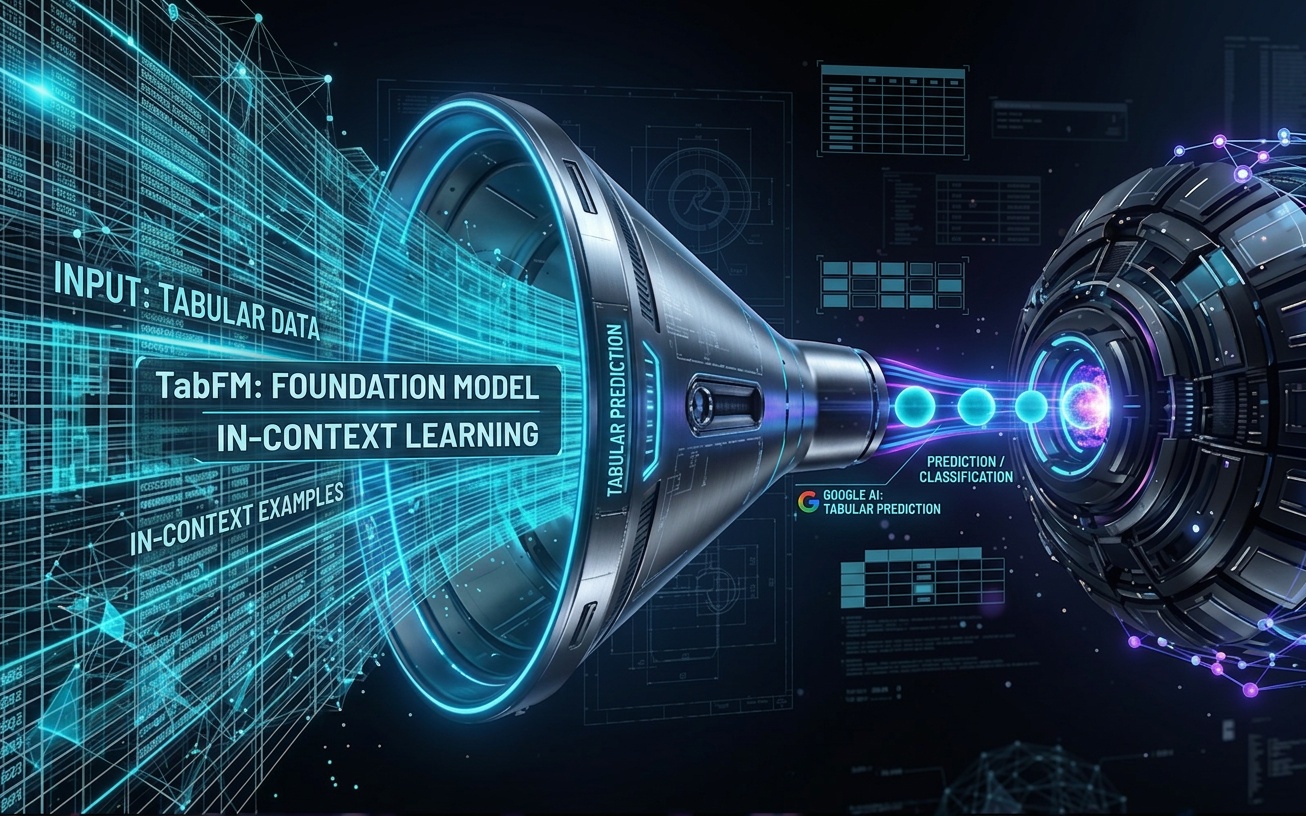
Google Research is proposing a way around that: a new foundation model called TabFM that treats tabular prediction as an in-context learning problem instead. It can generate predictions for a new, unseen table in a single forward pass.
This approach has the potential to revolutionize the way businesses interact with their data, making it easier to extract insights and make predictions without requiring extensive expertise in machine learning.
With TabFM, businesses can focus on using their data to drive decision-making, rather than spending time and resources on building and maintaining complex data pipelines.
The Challenge with Traditional ML
To extract reliable predictions from a gradient-boosted tree, data scientists must build and maintain complex data pipelines. They have to clean messy inputs, impute missing values, encode categorical variables into numerical formats, and engineer custom feature crosses.
Once the data is ready, they must run repetitive hyperparameter optimization loops, searching across learning rates, tree depths, subsampling ratios, and regularization grids to find the best configuration. This process is time-consuming and requires significant expertise.
Furthermore, traditional ML approaches often require a significant amount of labeled data, which can be difficult and expensive to obtain. This can limit the adoption of ML models, especially for smaller organizations or those with limited resources.
In addition, traditional ML models can be prone to overfitting, especially when dealing with small datasets. This can result in poor performance on unseen data, making it difficult to trust the predictions made by the model.
How TabFM Works
TabFM is designed to simplify the process of tabular prediction. It uses a single model to generate predictions for multiple tables, without requiring per-dataset training. This is achieved through in-context learning, where the model learns to adapt to new tables and generate predictions in a single forward pass.
The benefits of TabFM are numerous. It reduces the time-to-production from weeks of pipeline engineering to a single API call. This makes it ideal for enterprise developers and AI engineers who need to deploy models quickly and efficiently.
TabFM also eliminates the need for hyperparameter tuning, feature engineering, and retraining pipelines. This reduces the complexity and cost of deploying models, making it more accessible to a wider range of organizations.
In addition, TabFM can handle a wide range of tabular data, including data with missing values, categorical variables, and custom feature crosses. This makes it a versatile solution for a variety of use cases, from financial forecasting to customer segmentation.
Advantages of TabFM
TabFM has several advantages over traditional ML approaches. It eliminates the need for hyperparameter tuning, feature engineering, and retraining pipelines. This reduces the complexity and cost of deploying models, making it more accessible to a wider range of organizations.
Additionally, TabFM can handle a wide range of tabular data, including data with missing values, categorical variables, and custom feature crosses. This makes it a versatile solution for a variety of use cases, from financial forecasting to customer segmentation.
TabFM also has the potential to improve the accuracy of predictions, especially for small datasets. By using a single model to generate predictions for multiple tables, TabFM can leverage the knowledge learned from one table to improve the predictions made on another.
This approach can also help to reduce the risk of overfitting, as the model is not tailored to a specific dataset. Instead, it learns to adapt to new tables and generate predictions in a single forward pass.
Real-World Applications of TabFM
TabFM has a wide range of potential applications, from financial forecasting to customer segmentation. It can be used to predict customer churn, forecast sales, and identify trends in data.
In the financial sector, TabFM can be used to predict stock prices, forecast economic trends, and identify potential risks. It can also be used to predict credit risk, detect fraud, and optimize investment portfolios.
In the healthcare sector, TabFM can be used to predict patient outcomes, forecast disease trends, and identify potential health risks. It can also be used to optimize treatment plans, predict patient response to treatment, and identify potential side effects.
In addition, TabFM can be used in a variety of other industries, from marketing to supply chain management. It can be used to predict customer behavior, forecast demand, and optimize inventory levels.
Conclusion
Google's TabFM is a significant breakthrough in the field of tabular prediction. Its ability to generate predictions for unseen tables in a single forward pass makes it an attractive solution for enterprise developers and AI engineers. By simplifying the process of tabular prediction, TabFM has the potential to unlock new insights and opportunities for organizations across a wide range of industries.
TabFM has the potential to revolutionize the way businesses interact with their data, making it easier to extract insights and make predictions without requiring extensive expertise in machine learning.
As the amount of data continues to grow, TabFM is well-positioned to play a key role in helping organizations to extract value from their data and make better decisions.
Attribution: This article is based on a report by VentureBeat, available at https://venturebeat.com/technology/googles-tabfm-skips-per-dataset-training-and-still-predicts-on-tables-its-never-seen
The development of TabFM is a testament to the power of innovation and the potential for AI to transform the way we live and work. As TabFM continues to evolve and improve, it will be exciting to see the impact it has on the world of business and beyond.