Introduction to Inkling
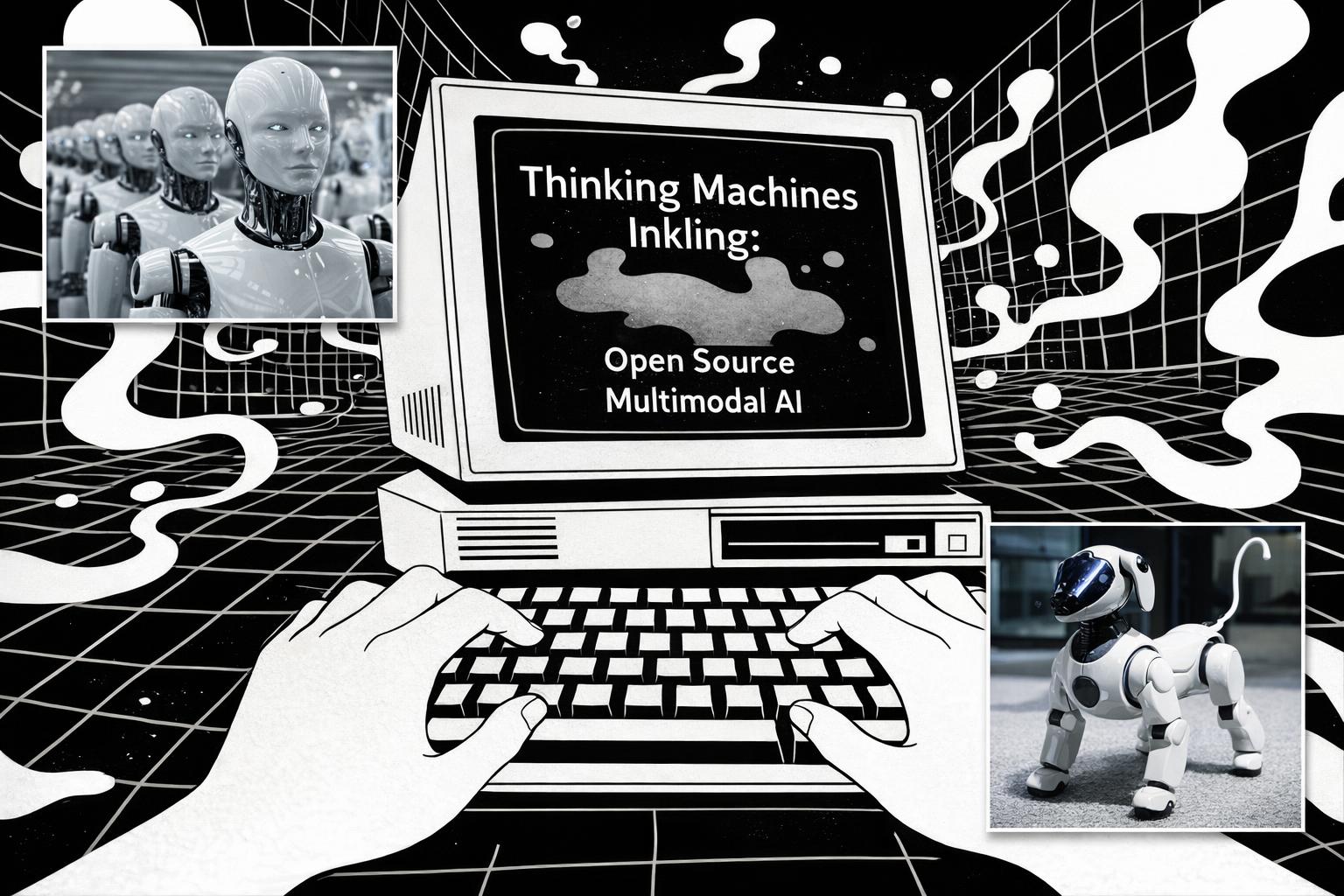
Today, Thinking Machines, a highly capitalized American AI startup, released Inkling, its first major language model under an enterprise-friendly Apache 2.0 open source license. Inkling boasts high, if sub state-of-the-art, performance for open weights models on third-party benchmarks, specifically software engineering and voice understanding.
Inkling is a natively multimodal, open-weights Mixture-of-Experts (MoE) system capable of reasoning across text, images, and other data types. With 975 billion total parameters, Inkling is a powerful tool for enterprises looking to move more of their agentic AI workloads to open weights models they can customize, control, and run on-premises or in virtual private clouds.
The release of Inkling is a significant development in the field of AI, as it provides enterprises with a cost-effective and customizable solution for their language processing needs. By open-sourcing Inkling, Thinking Machines is democratizing access to advanced AI technology and enabling a wider range of organizations to benefit from its capabilities.
Key Features of Inkling
Inkling was designed to answer directly on topics that may be subject to censorship, offering enterprises concerned about factual outputs, irrespective of controversy or sensitivity, a more trustworthy option. This is a key differentiator for Inkling, as many language models are limited by their training data and may not be able to provide accurate or unbiased responses on sensitive topics.
Some of the key features of Inkling include:
- High performance on third-party benchmarks, including software engineering and voice understanding
- Native multimodal capabilities, allowing for reasoning across text, images, and other data types
- Open-weights Mixture-of-Experts (MoE) system, allowing for customization and control
- Resistance to censorship, with the ability to answer directly on sensitive topics
In addition to these features, Inkling also offers a high degree of flexibility and scalability, making it suitable for a wide range of applications and use cases. Whether it's used for customer service, content generation, or data analysis, Inkling has the potential to revolutionize the way enterprises interact with their customers and process information.
Benefits for Enterprises
Inkling offers a number of benefits for enterprises, including low cost, customization, and control. By using an open source language model, enterprises can avoid the high costs associated with proprietary models and have more flexibility to customize and integrate the model into their existing systems.
In addition, Inkling's resistance to censorship makes it a more trustworthy option for enterprises that need to provide accurate and unbiased information to their users. This is particularly important for applications where factual accuracy is critical, such as in healthcare, finance, and education.
Another significant benefit of Inkling is its ability to help enterprises mitigate the risks associated with AI bias and censorship. By providing a transparent and explainable AI model, Inkling enables enterprises to build trust with their users and maintain a high level of integrity in their operations.
Furthermore, Inkling's open source nature allows enterprises to collaborate with other organizations and contribute to the development of the model. This can lead to a community-driven approach to AI development, where multiple stakeholders work together to create a more robust and reliable language model.
Technical Details of Inkling
Inkling is built using a combination of natural language processing (NLP) and computer vision techniques. The model uses a mixture-of-experts (MoE) architecture, which allows it to reason across multiple data types and modalities.
The MoE architecture is particularly well-suited for multimodal applications, where the model needs to process and integrate information from multiple sources. By using a MoE architecture, Inkling can leverage the strengths of different models and modalities to provide a more comprehensive and accurate understanding of the input data.
In addition to its MoE architecture, Inkling also uses a range of other techniques to improve its performance and robustness. These include data augmentation, regularization, and ensemble methods, which help to reduce overfitting and improve the model's ability to generalize to new and unseen data.
Conclusion
Inkling is a powerful and flexible language model that offers a number of benefits for enterprises. With its high performance, native multimodal capabilities, and resistance to censorship, Inkling is a strong contender for enterprises looking to move more of their agentic AI workloads to open weights models.
As the AI landscape continues to evolve, it will be interesting to see how Inkling and other open source language models shape the future of enterprise AI. With its focus on low cost, customization, and control, Inkling is well-positioned to play a major role in this evolution.
As the demand for AI technology continues to grow, it's likely that we'll see more open source language models like Inkling emerge. These models will provide enterprises with a range of options for building and deploying AI applications, and will help to drive innovation and adoption in the industry.
Article by Pitchbar Tech News, a leading source of news and analysis for the startup community. Source: venturebeat.com, URL: https://venturebeat.com/technology/thinking-machines-open-sources-first-multimodal-language-model-inkling-focused-on-low-cost-and-resistance-to-censorship