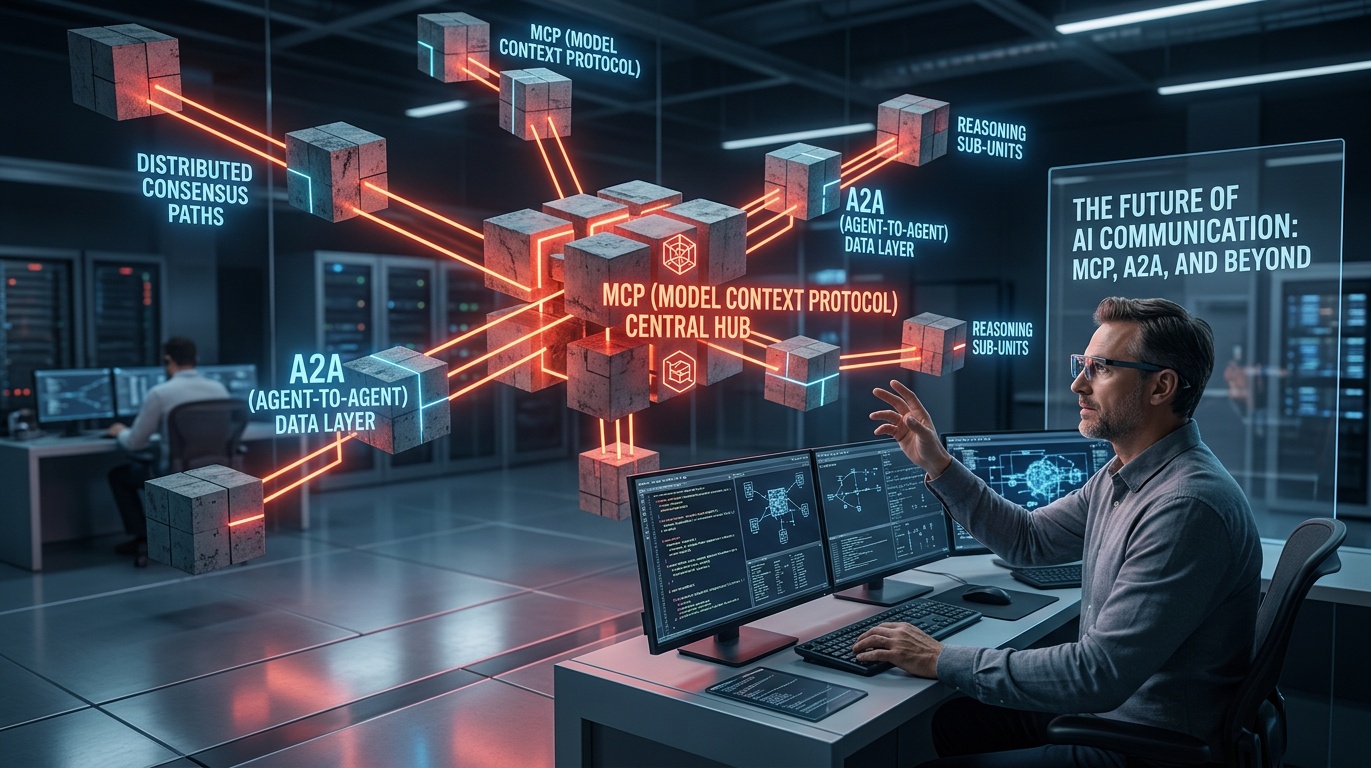
Introduction to AI Communication Protocols
The history of distributed computing is one of protocol proliferation followed by consolidation. Common Object Request Broker Architecture (CORBA), Distributed Component Object Model (DCOM), Java remote method invocation (RMI), and early simple object access protocol (SOAP) competed for the enterprise integration market in the late 1990s before representational state transfer (REST) quietly won by being simpler and HTTP-native.
Today, the AI agent ecosystem is currently in the proliferation phase. Four significant protocols have been published in the past eighteen months: Model context protocol (MCP) from Anthropic in late 2024, agent communication protocol (ACP) from IBM Research in March 2025, Agent2Agent (A2A) from Google in April 2025, and agent network protocol (ANP) from an independent group.
The proliferation of protocols in the AI agent ecosystem is driven by the need for more efficient and effective communication between agents. As the number of AI agents increases, the need for standardized communication protocols becomes more pressing. The development of protocols like MCP, A2A, and ANP is a step towards addressing this need.
The impact of these protocols on the AI ecosystem will be significant. They will enable agents to share context, coordinate actions, and communicate with each other more effectively. This, in turn, will lead to the development of more sophisticated and efficient AI systems.
The Role of MCP and A2A in AI Communication
MCP and A2A are two of the most promising protocols in the AI communication landscape. MCP provides a framework for agents to share context and coordinate actions, while A2A enables direct communication between agents.
Both protocols have the potential to revolutionize the way AI agents interact with each other and with humans. However, they also raise important questions about transport and interoperability. For example, how will agents using different protocols communicate with each other? How will they ensure that their messages are delivered reliably and efficiently?
MCP and A2A have different design goals and use cases. MCP is focused on providing a framework for agents to share context and coordinate actions, while A2A is focused on enabling direct communication between agents. This difference in design goals reflects the different needs of the AI ecosystem.
The development of MCP and A2A is a significant step towards addressing the need for standardized communication protocols in the AI ecosystem. However, more work is needed to ensure that these protocols are widely adopted and that they can interoperate with other protocols.
The Challenge of Transport in AI Communication
Transport is a critical component of AI communication, as it enables agents to exchange information and coordinate actions. However, the current state of transport in AI communication is fragmented and inefficient.
Several protocols, including MQTT and WebSockets, have carved out their respective niches in the transport landscape. However, a unified transport protocol that can support the diverse needs of AI agents is still lacking.
The lack of a unified transport protocol is a significant challenge for the AI ecosystem. It makes it difficult for agents to communicate with each other, and it limits the development of more sophisticated and efficient AI systems.
There are several approaches to addressing the challenge of transport in AI communication. One approach is to develop a new transport protocol that can support the diverse needs of AI agents. Another approach is to use existing protocols, such as MQTT and WebSockets, and to develop gateways and bridges that can enable communication between agents using different protocols.
Existing Transport Protocols and Their Limitations
MQTT and WebSockets are two of the most widely used transport protocols in the AI ecosystem. MQTT is a lightweight protocol that is well-suited for resource-constrained devices, while WebSockets is a more heavyweight protocol that is well-suited for applications that require bidirectional communication.
However, both MQTT and WebSockets have limitations. MQTT is not well-suited for applications that require high-throughput or low-latency communication, while WebSockets is not well-suited for applications that require reliable or secure communication.
Other transport protocols, such as HTTP and gRPC, are also used in the AI ecosystem. However, these protocols are not well-suited for real-time communication, and they are not optimized for the needs of AI agents.
The limitations of existing transport protocols reflect the need for a new transport protocol that can support the diverse needs of AI agents. This protocol should be lightweight, efficient, and scalable, and it should be optimized for real-time communication.
Conclusion and Future Directions
The future of AI communication is exciting and rapidly evolving. As the AI agent ecosystem continues to converge on new protocols, we can expect to see significant advances in transport and interoperability.
However, it is crucial to address the challenge of transport in AI communication. A unified transport protocol that can support the diverse needs of AI agents is essential for the development of more sophisticated and efficient AI systems.
The development of a unified transport protocol will require collaboration and coordination among stakeholders in the AI ecosystem. It will also require significant investment in research and development, as well as testing and validation.
Despite the challenges, the potential benefits of a unified transport protocol are significant. It will enable AI agents to communicate with each other more effectively, and it will enable the development of more sophisticated and efficient AI systems.
Attribution: This article was written by the Pitchbar tech news editor for the startup community.