Introduction to AI Agents in Production
Enterprise teams have witnessed the same phenomenon time and time again. An AI agent performs beautifully in demos, but once it goes into production, it stalls. The agent may run for a short period, but soon it requires human intervention to top up its context and check its output, thereby draining the promised efficiency into supervision.
This is a major reason why many agent pilots never make it to production systems. The ideal scenario is to have an agent that can run a long job on its own, overnight if necessary, and only require human validation for the last 10% of the output.
The ability of an AI agent to maintain context is crucial for its success in production. Context loss can occur due to various reasons, including the limitations of current AI models, the complexity of the tasks, and the lack of relevant data. As a result, AI agents often require human intervention to recover from context loss, which can be time-consuming and costly.
Moreover, the problem of context loss is not limited to AI agents. It can also affect other machine learning models, such as those used in natural language processing, computer vision, and recommender systems. Therefore, it is essential to develop solutions that can mitigate context loss and improve the performance of AI agents and other machine learning models.
The Problem with Current AI Models
When AI firm Chroma tested 18 leading models, every single one lost accuracy as the input grew. This is a property of how attention works in these models, and it's not a gap that can be closed by a stronger model. In other words, an agent that is fed more and more data does not become more accurate; instead, it becomes less accurate.
This is the underlying issue that the orchestration conversation often skips. Routing, durable execution, and observability all assume that each agent is already competent enough to coordinate in the first place. However, the deeper question is how long an agent can run before a human has to step in, and this comes down to the agent's ability to maintain context.
The problem with current AI models is that they are not designed to handle complex tasks that require a deep understanding of context. They are often trained on limited datasets and are not able to generalize well to new situations. As a result, they can become less accurate over time, requiring human intervention to correct their mistakes.
Furthermore, current AI models are often based on a fixed architecture that is not adaptable to changing circumstances. They are not able to learn from their mistakes and improve their performance over time. This lack of adaptability can lead to a decrease in accuracy and an increase in the need for human intervention.
Hypernetworks: A Solution to Context Loss
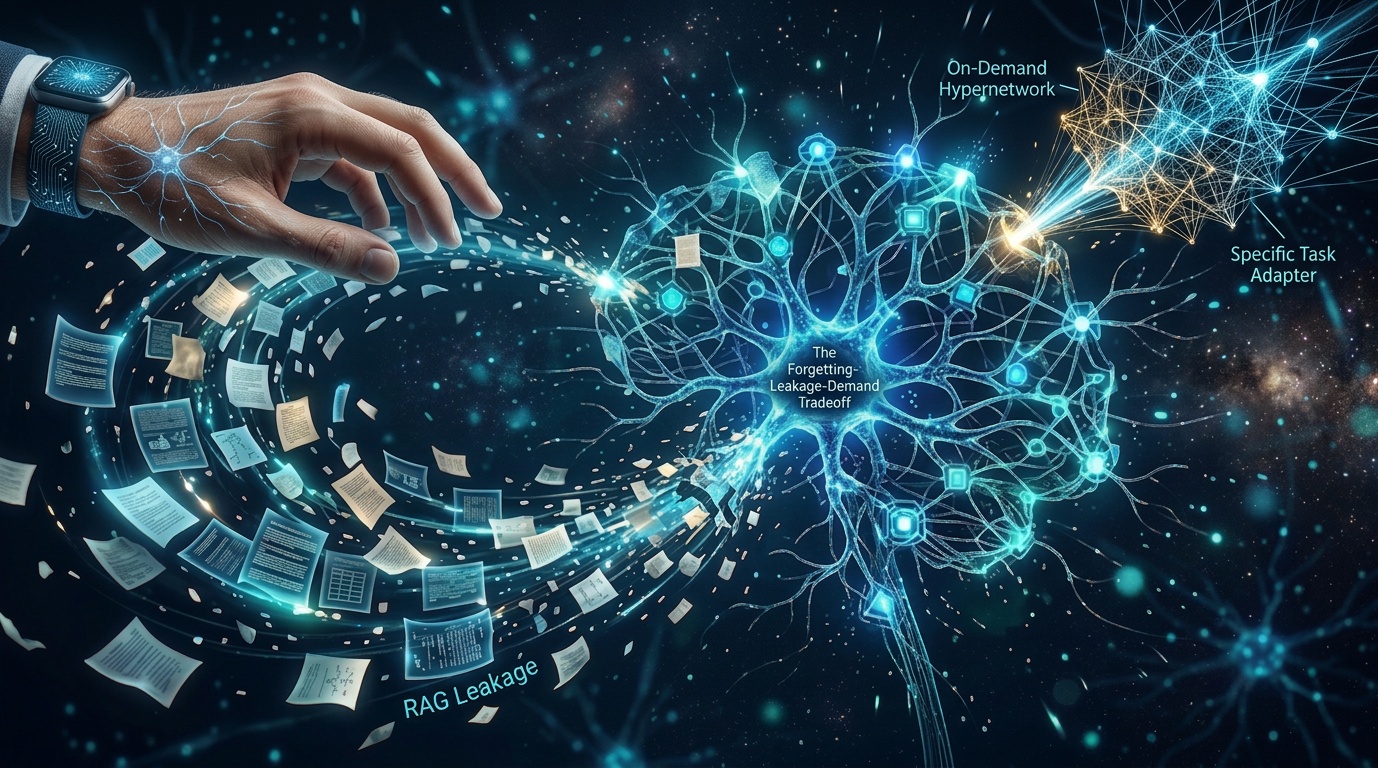
Hypernetworks may hold the key to building models on demand, which can help AI agents run longer without human intervention. By building models on demand, hypernetworks can provide the context that agents need to perform their tasks accurately.
Here are some benefits of using hypernetworks:
- Improved accuracy: Hypernetworks can build models that are tailored to the specific task at hand, which can improve accuracy.
- Increased efficiency: By reducing the need for human intervention, hypernetworks can increase the efficiency of AI agents.
- Reduced supervision: Hypernetworks can reduce the need for human supervision, which can free up resources for more strategic tasks.
Hypernetworks are a type of neural network that can generate other neural networks. They are trained on a dataset of tasks and can learn to generate models that are tailored to each task. This allows them to provide the context that AI agents need to perform their tasks accurately.
Moreover, hypernetworks can be used to build models that are adaptable to changing circumstances. They can learn from their mistakes and improve their performance over time, reducing the need for human intervention. This adaptability can lead to an increase in accuracy and a decrease in the need for human supervision.
How Hypernetworks Work
Hypernetworks work by generating models on demand. They are trained on a dataset of tasks and can learn to generate models that are tailored to each task. This allows them to provide the context that AI agents need to perform their tasks accurately.
The process of generating models on demand involves several steps. First, the hypernetwork is trained on a dataset of tasks. This training data is used to learn the patterns and relationships between the tasks and the models that are generated to solve them.
Once the hypernetwork is trained, it can be used to generate models on demand. This involves providing the hypernetwork with a task and allowing it to generate a model that is tailored to that task. The generated model can then be used to perform the task, providing the context that the AI agent needs to perform its tasks accurately.
The use of hypernetworks can be beneficial in a variety of applications, including natural language processing, computer vision, and recommender systems. They can be used to build models that are adaptable to changing circumstances and can learn from their mistakes, reducing the need for human intervention.
Conclusion
In conclusion, AI agents often stall in production due to context loss. Hypernetworks may hold the key to building models on demand, which can help AI agents run longer without human intervention. By understanding the problem of context loss and the potential solution offered by hypernetworks, enterprise teams can take the first step towards building more efficient and accurate AI systems.
The use of hypernetworks can be beneficial in a variety of applications, including natural language processing, computer vision, and recommender systems. They can be used to build models that are adaptable to changing circumstances and can learn from their mistakes, reducing the need for human intervention.
Moreover, the development of hypernetworks can lead to a new generation of AI agents that are more efficient, accurate, and adaptable. These agents can be used to automate a variety of tasks, freeing up human resources for more strategic and creative tasks.
Attribution: This article was written by the Pitchbar tech news editor for the startup community, based on an original article from VentureBeat: https://venturebeat.com/orchestration/fine-tuning-forgets-rag-leaks-context-hypernetworks-build-the-model-your-agent-needs-on-demand