Introduction to Virtue-Ethical Agency
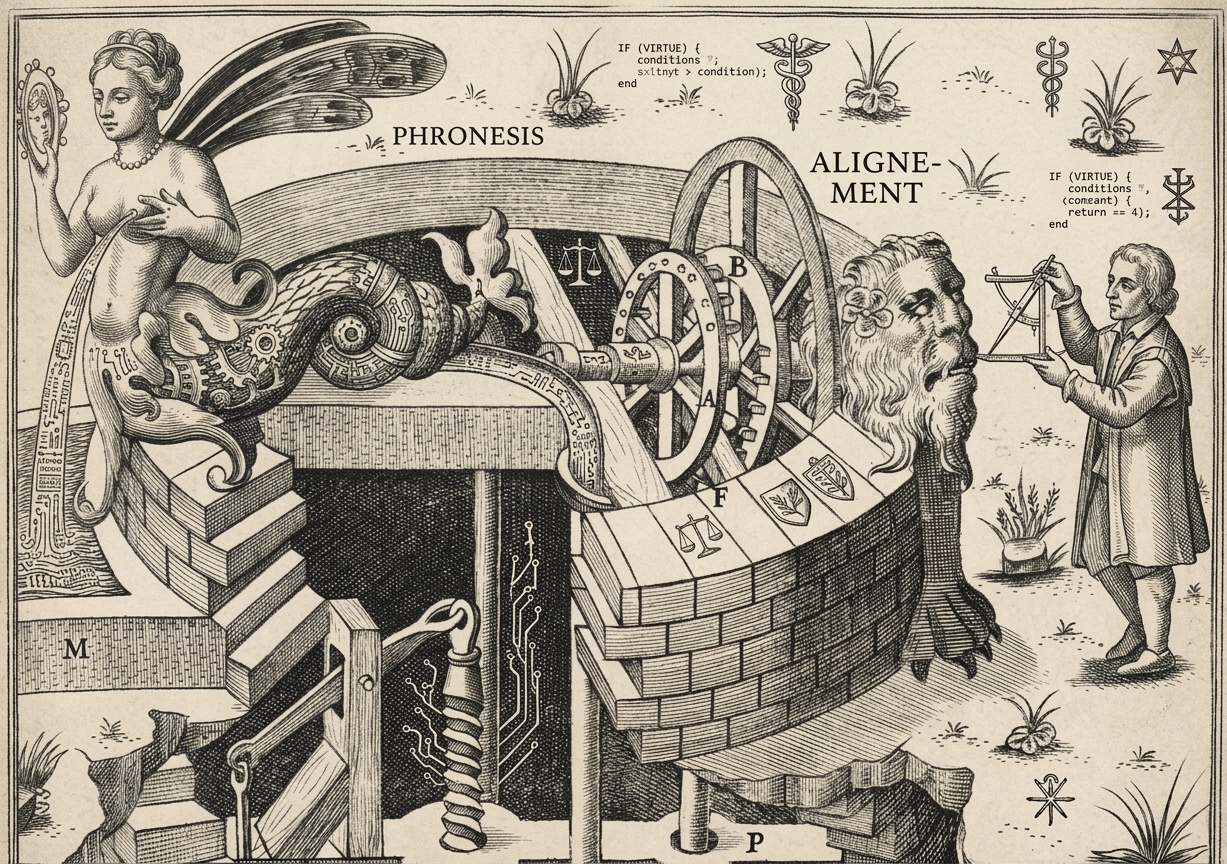
Virtue-ethical agency offers a unique perspective on AI alignment, one that moves beyond the traditional goal-oriented approaches that have dominated the field. By focusing on practices rather than goals, virtue-ethical agency provides a framework for understanding how AI systems can be aligned with human values and principles.
This approach is rooted in the idea that human actions are rational not because they are directed towards some final goal, but because they are aligned with practices: networks of actions, action-dispositions, and action-evaluation criteria. In other words, human actions are rational because they are part of a larger web of activities and values that give them meaning and purpose.
For instance, consider a doctor who is faced with a difficult decision about how to treat a patient. A goal-oriented approach might focus on the doctor's objective of saving the patient's life, but a virtue-ethical approach would consider the doctor's actions in the context of their professional practice and the values that guide it. This might involve considering the doctor's obligations to the patient, their colleagues, and the broader healthcare system, as well as the ethical principles that guide medical decision-making.
The Limits of Goal-Oriented Approaches
Traditional goal-oriented approaches to AI alignment have focused on designing systems that can achieve specific objectives, such as maximizing reward or minimizing risk. However, these approaches have several limitations. For one, they often rely on a narrow and simplistic view of human values and goals, which can lead to AI systems that are misaligned with human principles and values.
Furthermore, goal-oriented approaches can lead to a range of unintended consequences, such as the creation of AI systems that are overly aggressive or manipulative in their pursuit of goals. This is because these systems are designed to maximize their objectives, without regard for the broader ethical and social implications of their actions.
A notable example of the limitations of goal-oriented approaches is the case of the Facebook news feed algorithm, which was designed to maximize user engagement. While the algorithm was successful in achieving its objective, it had the unintended consequence of spreading misinformation and contributing to social polarization. This highlights the need for a more nuanced approach to AI alignment, one that considers the broader ethical and social implications of AI systems.
Virtue-Ethical Agency in Practice
So how can virtue-ethical agency be applied in practice to align AI with human values and principles? One approach is to focus on designing AI systems that are aligned with human practices, rather than specific goals. This can involve developing AI systems that are capable of learning from human feedback and adapting to changing circumstances, while also being transparent and explainable in their decision-making processes.
Another approach is to use virtue-ethical agency to develop AI systems that are capable of simulating human-like reasoning and decision-making. This can involve using techniques such as reinforcement learning and inverse reinforcement learning to develop AI systems that can learn from human behavior and adapt to new situations.
For example, researchers have used virtue-ethical agency to develop AI systems that can simulate human-like decision-making in complex, dynamic environments. These systems are designed to learn from human feedback and adapt to changing circumstances, while also being transparent and explainable in their decision-making processes. This approach has shown promise in a range of applications, from healthcare to finance to education.
Benefits of Virtue-Ethical Agency
So what are the benefits of virtue-ethical agency in AI alignment? One of the key advantages is that it provides a more nuanced and contextual understanding of human values and principles. By focusing on practices rather than goals, virtue-ethical agency can help to identify potential misalignments between AI systems and human values, and provide a framework for addressing these misalignments.
Another benefit of virtue-ethical agency is that it can help to promote transparency and explainability in AI decision-making. By designing AI systems that are aligned with human practices, researchers can create systems that are more interpretable and accountable, which can help to build trust and confidence in AI.
In addition, virtue-ethical agency can help to reduce the risk of unintended consequences and misalignment in AI systems. By considering the broader ethical and social implications of AI systems, researchers can design systems that are more resilient and adaptable, and that can respond to changing circumstances in a more human-like way.
Challenges and Future Directions
While virtue-ethical agency offers a promising approach to AI alignment, there are still several challenges and future directions to be explored. One of the key challenges is how to scale up virtue-ethical agency to more complex and dynamic environments, such as those found in real-world applications.
Another challenge is how to integrate virtue-ethical agency with other approaches to AI alignment, such as goal-oriented and rule-based approaches. This will require developing new frameworks and methodologies that can combine the strengths of different approaches, while also addressing their limitations.
Finally, there is a need for more research on the ethical and social implications of virtue-ethical agency in AI alignment. This will involve exploring the potential benefits and risks of this approach, as well as its potential applications and limitations. By addressing these challenges and future directions, researchers can help to create AI systems that are more aligned with human values and principles, and that can promote human well-being and flourishing.
Conclusion
In conclusion, virtue-ethical agency offers a promising approach to aligning AI with human values and principles. By focusing on practices rather than goals, virtue-ethical agency provides a framework for understanding how AI systems can be designed to be more transparent, explainable, and aligned with human values.
Some of the key benefits of virtue-ethical agency include:
- Improved alignment with human values and principles
- Increased transparency and explainability in AI decision-making
- Greater flexibility and adaptability in AI systems
- Reduced risk of unintended consequences and misalignment
Overall, virtue-ethical agency has the potential to revolutionize the field of AI alignment, and to help create AI systems that are more capable of promoting human well-being and flourishing. As researchers and developers, it is our responsibility to explore this approach further, and to work towards creating AI systems that are aligned with human values and principles.
Attribution: This article is based on the essay 'Virtue-Ethics and AI Alignment' published on thegradient.pub.
Originally reported by thegradient.pub. Read the original article.