Introduction to AI's Memory Wall
Artificial intelligence (AI) has made tremendous progress in recent years, with advancements in compute power and model architectures. However, as AI workloads evolve from discrete question-and-answer exchanges to persistent, multi-step agentic systems, a new bottleneck has emerged: context management.
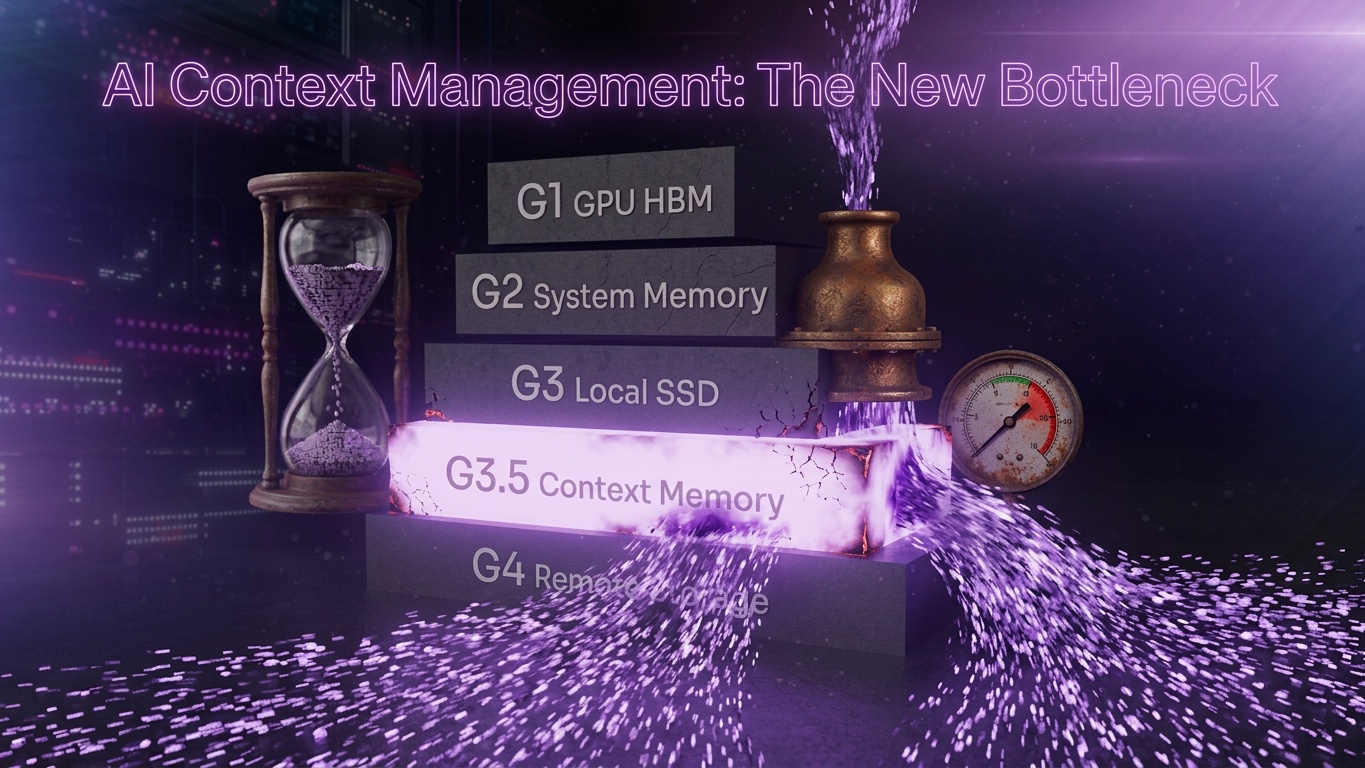
According to Jeff Harthorn, AI applied research lead at Solidigm, context management has become the primary bottleneck in AI development, surpassing GPU availability and compute efficiency. This is due to the growing need for persistent state tracking, as agentic AI systems chain dozens or hundreds of model calls together, each generating state that must be tracked.
The implications of this trend are far-reaching, with potential consequences for the development and deployment of AI systems. As AI continues to advance, it is essential that we address the context management bottleneck to ensure that AI systems can deliver accurate and reliable results.
Furthermore, the context management bottleneck has significant implications for the future of AI research and development. As AI systems become increasingly complex, the need for effective context management will only continue to grow, making it essential that we prioritize the development of new context management solutions.
The Impact of Growing Context Windows
Context windows are growing dramatically, making individual inputs far larger than before. This trend is driven by the increasing complexity of AI workloads, which require more data and context to produce accurate results. As a result, the volume of context data is growing exponentially, pushing beyond what existing memory tiers were designed to handle.
The consequences of this trend are significant. Without a new context tier to support persistent state tracking, AI systems will struggle to deliver accurate and reliable results. This will hinder the adoption of AI in industries such as healthcare, finance, and transportation, where accuracy and reliability are paramount.
In addition, the growing context windows have significant implications for the design and development of AI systems. As context windows continue to grow, AI systems will require more advanced context management capabilities to handle the increased volume of context data.
For example, in the field of natural language processing, the growing context windows have led to the development of more advanced language models, such as transformers, which are capable of handling longer context windows and delivering more accurate results.
The Need for a New Context Tier
To address the context management bottleneck, a new context tier is needed. This tier should be designed to handle the growing volume of context data, providing a scalable and efficient solution for persistent state tracking.
Several approaches are being explored to address this need, including the development of new memory architectures and the use of distributed computing systems. These solutions will enable AI systems to handle the growing volume of context data, ensuring that AI continues to deliver accurate and reliable results.
One potential approach to addressing the context management bottleneck is the development of hybrid memory architectures, which combine traditional memory technologies with emerging technologies such as phase-change memory and spin-transfer torque magnetic recording.
Another approach is the use of distributed computing systems, which can provide a scalable and efficient solution for persistent state tracking. By distributing the context data across multiple nodes, AI systems can handle the growing volume of context data and deliver accurate and reliable results.
Emerging Solutions and Technologies
Several emerging solutions and technologies are being developed to address the context management bottleneck. These include the development of new memory architectures, such as hybrid memory architectures, and the use of distributed computing systems.
In addition, researchers are exploring the use of emerging technologies such as quantum computing and neuromorphic computing to address the context management bottleneck. These technologies have the potential to provide a scalable and efficient solution for persistent state tracking, enabling AI systems to deliver accurate and reliable results.
For example, quantum computing has the potential to provide a significant boost to AI systems, enabling them to handle complex computations and deliver accurate results. Similarly, neuromorphic computing has the potential to provide a scalable and efficient solution for persistent state tracking, enabling AI systems to handle the growing volume of context data.
Furthermore, the development of emerging solutions and technologies has significant implications for the future of AI research and development. As these solutions and technologies continue to evolve, they will play an increasingly important role in addressing the context management bottleneck and enabling AI systems to deliver accurate and reliable results.
Conclusion
In conclusion, the growth of AI is being hindered by context management, which has become the primary bottleneck in AI development. To address this bottleneck, a new context tier is needed, one that can handle the growing volume of context data and provide a scalable and efficient solution for persistent state tracking.
As the AI industry continues to evolve, it is essential that we prioritize the development of new context management solutions. By doing so, we can ensure that AI continues to deliver accurate and reliable results, driving innovation and growth in industries around the world.
The development of new context management solutions will require significant investment and research, but the potential benefits are substantial. By addressing the context management bottleneck, we can unlock the full potential of AI and enable it to deliver accurate and reliable results in a wide range of applications.
Attribution: This article was written by the Pitchbar tech news editor, based on an article from venturebeat.com.
Originally reported by venturebeat.com. Read the original article.