Introduction to LongCat-2.0
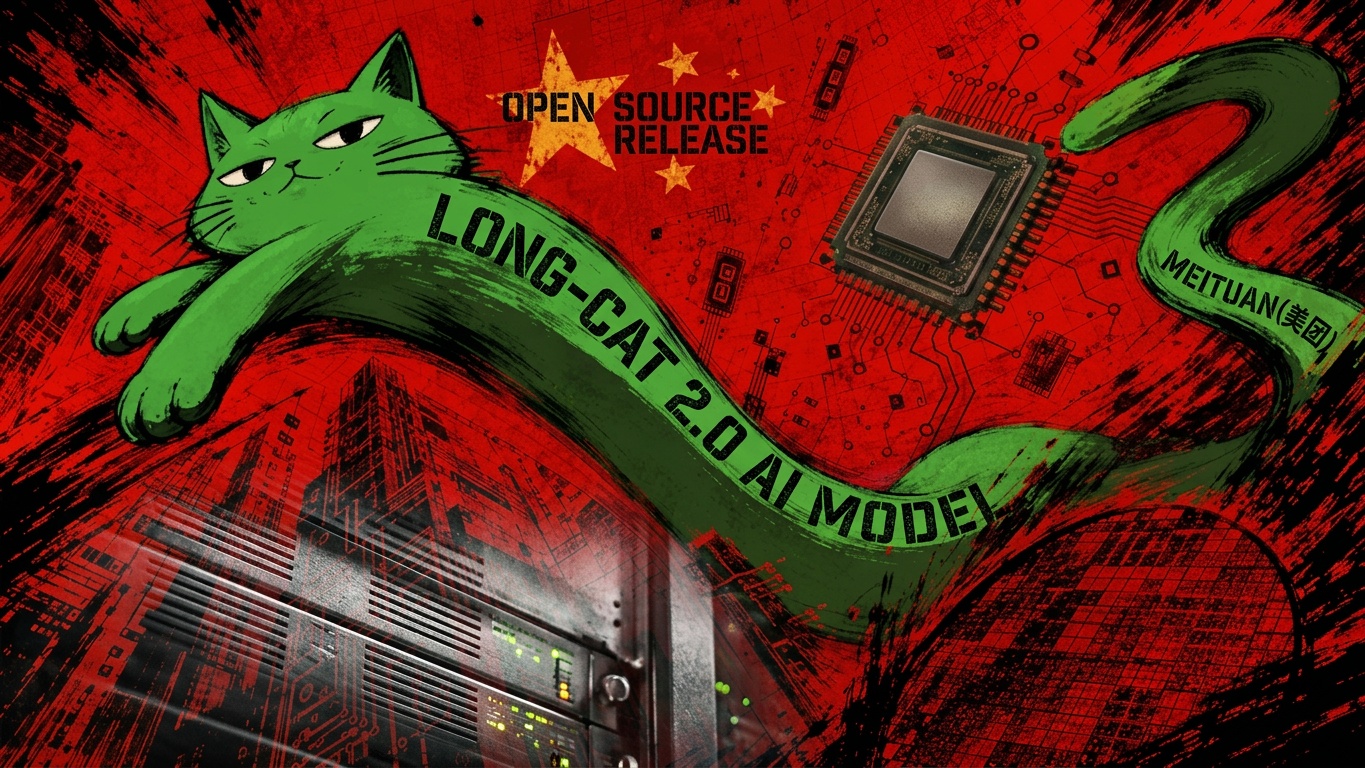
Meituan, a Chinese delivery app company, has officially unveiled LongCat-2.0 on GitHub, Hugging Face, and its native platform. This 1.6-trillion-parameter Mixture-of-Experts (MoE) system is the computational engine behind 'Owl Alpha,' the anonymous stealth model that has spent the last two months commanding global developer charts on OpenRouter.
LongCat-2.0 is designed to fundamentally disrupt closed-source enterprise dominance in autonomous software engineering. The model brings a native 1-million-token context window to the public domain under a highly permissive, enterprise-grade, commercially viable MIT license.
The open sourcing of LongCat-2.0 is a significant move by Meituan, as it allows developers to access and build upon the model, potentially leading to further innovations and advancements in the field. The use of Chinese chips for training the model is also notable, as it highlights the growing capabilities of China's tech industry.
The LongCat-2.0 model has been trained on a massive dataset, allowing it to learn complex patterns and relationships in code. This enables it to generate high-quality code snippets and even entire programs, making it a valuable tool for developers. The model's ability to learn from and adapt to new data also makes it a promising candidate for a wide range of applications, from software development to data analysis.
Key Features of LongCat-2.0
The LongCat-2.0 model has several key features that make it an attractive option for developers. These include:
- A 1.6-trillion-parameter Mixture-of-Experts (MoE) system
- A native 1-million-token context window
- A highly permissive, enterprise-grade, commercially viable MIT license
However, the company has yet to post the full weights — both the Github and Hugging Face pages say 'Model weights coming soon — stay tuned!'
The LongCat-2.0 model's architecture is designed to be highly flexible and adaptable, allowing it to be fine-tuned for a wide range of tasks and applications. The use of a Mixture-of-Experts (MoE) system enables the model to learn complex patterns and relationships in code, and the native 1-million-token context window provides a high level of context awareness.
The MIT license under which the model is released is also significant, as it allows developers to use and modify the model for commercial purposes. This could lead to the development of new products and services based on the LongCat-2.0 model, and further accelerate the growth of the AI and machine learning industry.
Commercial Access to LongCat-2.0
Commercial access to the LongCat-2.0 architecture introduces a highly aggressive pricing tier. The mechanism deploys a system where all context-cache hits are processed completely free of charge, running alongside a time-limited 'Token Pack' flash-sale paradigm.
There's also a typical 'pay-as-you-go' API for non-cache hits standard priced at $0.75/$2.95 per million tokens in/out. However, a limited-time promotional discount aggressively slashes these prices.
The commercial access model is designed to be highly attractive to developers, with a low-cost entry point and a flexible pricing structure. The use of a context-cache system allows developers to reduce their costs by reusing previously computed results, and the 'pay-as-you-go' API provides a predictable and scalable pricing model.
The limited-time promotional discount is also a significant incentive for developers to try out the LongCat-2.0 model, as it provides a low-risk opportunity to evaluate the model's capabilities and potential applications. As the model continues to evolve and improve, it is likely that the commercial access model will also be refined and expanded to meet the needs of developers and the growing demand for AI and machine learning solutions.
Technical Details of LongCat-2.0
The LongCat-2.0 model is a highly complex and sophisticated AI system, with a large number of parameters and a deep architecture. The model is trained using a combination of supervised and unsupervised learning techniques, and is optimized for a wide range of tasks and applications.
The use of Chinese chips for training the model is also notable, as it highlights the growing capabilities of China's tech industry. The model's performance is also highly competitive with other state-of-the-art models, and it has the potential to be used in a wide range of applications, from software development to data analysis.
The technical details of the LongCat-2.0 model are highly complex and sophisticated, and are likely to be of interest to developers and researchers in the field of AI and machine learning. The model's architecture and training procedures are designed to be highly flexible and adaptable, allowing it to be fine-tuned for a wide range of tasks and applications.
The LongCat-2.0 model is also highly scalable, and can be deployed on a wide range of hardware platforms, from cloud-based services to on-premises deployments. The model's performance is also highly optimized, with a low latency and high throughput, making it suitable for real-time applications and high-performance computing environments.
Conclusion
Meituan's LongCat-2.0 is a significant development in the field of autonomous software engineering. The open sourcing of this model under a MIT license has the potential to disrupt closed-source enterprise dominance and provide developers with a highly capable and flexible tool.
As the model continues to evolve and improve, it will be interesting to see how it is adopted and utilized by the developer community. For now, LongCat-2.0 is an exciting and promising development in the world of AI and machine learning.
The potential applications of the LongCat-2.0 model are highly diverse and widespread, and are likely to have a significant impact on the tech industry as a whole. The model's ability to generate high-quality code snippets and entire programs makes it a valuable tool for developers, and its potential applications in data analysis and other fields are also highly significant.
This article was written by the Pitchbar tech news editor for a startup community. The information contained in this article is for general information purposes only, and is not intended to be taken as professional advice. Readers should always consult with a qualified expert before making any decisions related to the topics discussed in this article.
Source: venturebeat.com